
Visit the Texas Water Company Water Conservation webpage for helpful tips on conserving water and using it wisely.
The water we use today is the water you and others saved yesterday. When you make thoughtful decisions about water use, you help protect water supplies for yourself, your family, and your community today and in the future.
Drought stages are one way that water utilities, like Texas Water Company, help community members understand the status of the water supply we all share. They also highlight actions each of us can take to ensure access to one of our most vital resources: water.
In the Texas Water Company’s service area – which spans from Travis County to Medina County, passing through Bandera, Comal, Blanco, Hays, and Kendall counties – the varieties of local geology, water sources, water infrastructure, and peoples’ consumption patterns make managing drought stages a unique challenge. As a result of these differences, drought stages are specific to each service area.
In other words, each county may be subject to different drought stages and conservations actions at the same time of year. For example, because of its geographic location, one of the state wells is a key drought trigger for Kendall County, while Canyon Lake level is an important trigger for Comal County. Depending on how the state well and Canyon Lake are performing, Kendall County and Comal County could be in different drought stages at the same time.
Additionally, drought conditions can shift quickly. Weather, water supply, system demand, and customer water use all play a role. If conditions become drier or demand rise sharply, drought stages may need to be increased, and drought restrictions can become stricter to protect our shared water supplies and for Texas Water Company to ensure reliable service for everyone.
This collaborative effort for responsible water management involves Texas Water Company and every single individual, business, school and other water customer in our service areas.
At Texas Water Company, we do our part by installing, improving and maintaining the infrastructure to deliver water to our customers, and by making every drop count through actions like using reclaim water to flush toilets and catching stormwater to recharge into the ground. Customers can help make thoughtful use of water by reducing outdoor water use, fixing leaks on their property, choosing drought-resistant landscaping, and following watering schedule and drought stages directions.
In our service area, we use a Stage 0 through Stage 5 drought plan, where each level increases conservation efforts as water conditions worsen. The goal is to gradually reduce water use to protect essential supply.
The big picture of Texas Water Company drought stage increases:
Stage 0 → 1: Reduce watering frequency
Stage 1 → 2: Shift to limited (biweekly) irrigation
Stage 2 → 3: Continue with biweekly irrigation and increase restrictions on non-essential water activities
Stage 3 → 4: Prohibit all outdoor water use
Stage 4 → 5: Increase restrictions on water use and reducing consumption for high water users
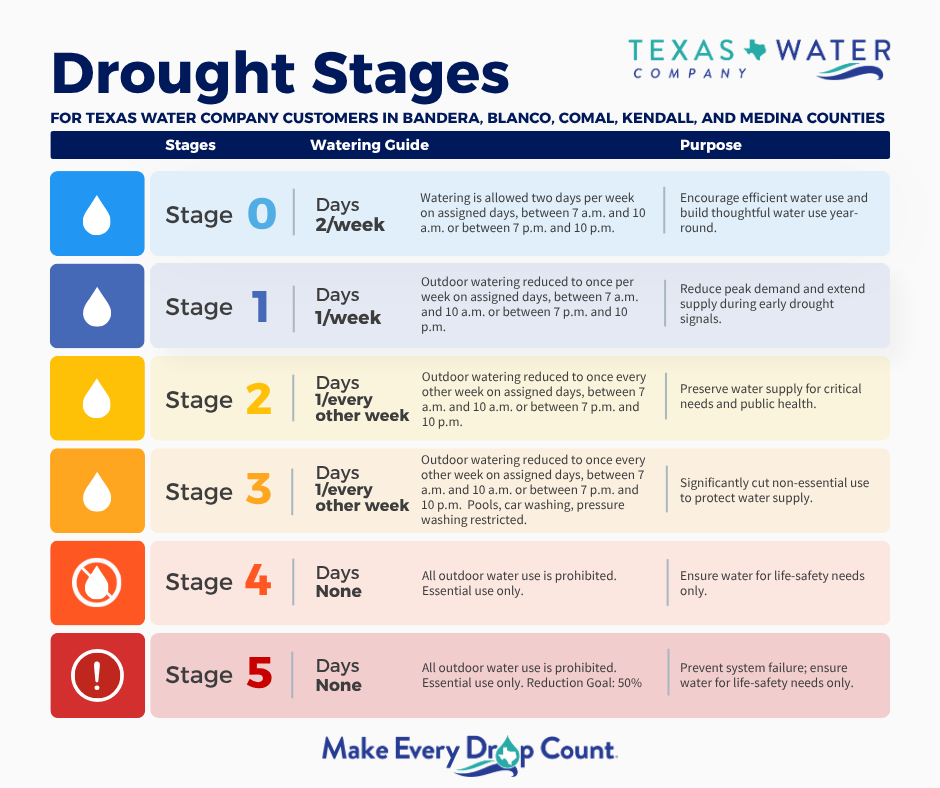
Landscape watering schedules vary based on both your county and the last digit of your address, so watering days are not the same for everyone.
While many drought–causing conditions are outside our control, how we use water every day makes a real difference. Even when drought conditions improve, summer demand remains high, and simple actions like adjusting your sprinkler schedule or fixing a leaking outdoor faucet can help reduce strain on the system’s infrastructure, supporting consistent water pressure and reliable service for you and your entire community.
Watering schedules are highly important to support a healthy water system for each user. Schedules help spread water use across the week, so the system is not hit with one large spike in demand. When too many people water at the same time, especially during hot summer months, the system can face significant operational challenges that risk water reliability for users.
Think of it like a neighborhood watering lawns all at once on a Sunday morning. Although the water supply may be available, the sudden peak in use can put stress on pumps in the system, which can lead to issues like low water pressure or even no water. Following the watering guide helps smooth out those peaks and supports reliable service.
Check the Texas Water Company Water Conservation website for your County-specific drought stages and watering schedules.
Drought stage decisions are based on a multi-faceted picture, not only on rainfall alone. To determine a drought stage for each area we serve, Texas Water Company considers:
Even though you may experience variances in drought stages at different times throughout the year, it’s still essential to follow your assigned watering schedule to help keep the system running smoothly for you and others. Texas Water Company is taking a measured approach to conservation, balancing current conditions with long-term system reliability.
Drought stages can also change quickly as weather, demand, and supply shift, so staying informed and adjusting your water use is key. After all, the water we use today is the water you and others saved yesterday — and understanding what each stage requires helps you take meaningful actions to protect our shared water supply.
Check your current watering schedule here.