
Canyon Lake is one of Comal County’s most treasured shared resources and one of the most breathtaking reservoirs in South-Central Texas. Created in 1964 to provide flood control and a dependable water supply throughout the Guadalupe River Basin, the reservoir also plays an important role in Texas Water Company’s (TWC) water portfolio. For TWC, Canyon Lake is a major surface-water source that helps provide drinking water to about 25,102 households in our service areas.
One of the main factors in Texas water regulation is the distinction between groundwater and surface water. Along with rivers, streams, and other reservoirs, Canyon Lake is a surface water reservoir, and surface-water rights are primarily regulated by the Texas Commission on Environmental Quality (TCEQ).
However, oversight and administration of the Reservoir are complex. Federal, state, and local entities all play different roles in protecting Canyon Lake’s water supply, ecosystem, recreational uses, and flood-control functions. Major players involved in Canyon Lake water regulation include:
The role of TWC is to plan for and deliver reliable and high-quality water to our customers by managing our allocated water supply wisely and providing dependable service to our customers every day. TWC is subject to water rights, agreements, and drinking water allocations established through TCEQ and GBRA. In simple terms: TCEQ establishes the water rights and the amount of water that can be diverted from the reservoir to supply water users; GBRA manages stored water and contracts water allocations; and TWC is one of those contracted users.
Each year, GBRA can divert an average of 90,000 acre-feet of stored water to meet the needs of contracted water users. TWC has access to 6.81% of that annual contracted amount. Importantly, TWC’s supply is a fixed share of a fixed amount, not a percentage of Canyon Lake’s total water volume. This means TWC’s allocation does not automatically increase when lake levels are high, and it does not change simply because more water is stored in the lake.
A common misconception is that all the water in Canyon Lake is available to surrounding communities and contracted water suppliers. That is not the case. To protect the lake, its environment, and its many uses, only a portion of Canyon Lake’s water is available for drinking water supply.
Canyon Lake’s conservation, or normal full, pool capacity is roughly 378,852 acre-feet, or about 123.45 billion gallons of water. GBRA may withdraw an average of 90,000 acre-feet of stored water each year, equal to about 29.3 billion gallons. TWC’s contracted drinking water allocation is 6,130 acre-feet per year, or about 1.99 billion gallons. Put another way, Canyon Lake’s conservation pool could fill approximately 187,000 Olympic-size swimming pools; GBRA’s annual contracted supply amount could fill roughly 36,000; and TWC’s contracted drinking water allocation could fill about 2,500.
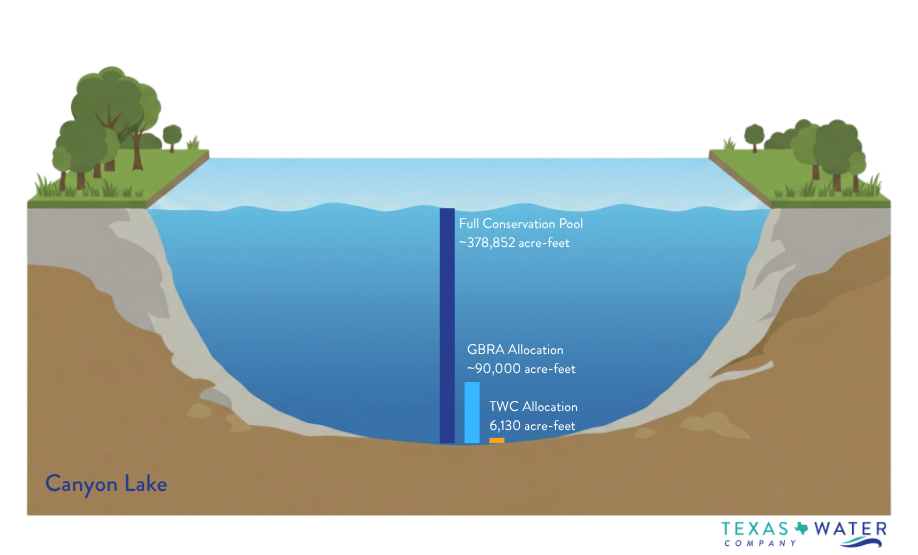
Another common misconception is the belief that the annually allocated 1.99 billion gallons (approx.) of water can be delivered through the distribution system without limitation. In reality, pipes, treatment plants, and storage tanks are designed to meet specific water demand levels and have physical capacity limits.
For example, if an entire neighborhood begins watering lawns at the same time outside of the designated irrigation schedule, the utility cannot simply divert more water from the lake to meet the sudden increase in demand. Water must still move through a system with finite capacity. If the pipelines serving that neighborhood are designed to deliver a maximum flow of 1,000 gallons per minute, they cannot instantly provide 1,500 gallons per minute. This is why watering schedules are important. They help balance demand across the system, allowing infrastructure to operate efficiently and reliably for everyone.
The amount of water in Canyon Lake and Texas Water Company’s authorized water supply are connected, but they are not the same. Canyon Lake’s water level rises and falls over time, but TWC’s water supply from the lake is based on a contractual allocation established through GBRA. Our supply is tied to a defined annual contract amount, not the total amount of water stored in Canyon Lake.
Understanding water allocation helps customers and community partners better understand how long-term water planning works. TWC’s allocation supports reliable service, but it is limited and fixed. Managing that supply carefully helps us plan ahead, respond to changing water conditions, and provide clear, consistent information as community questions arise.
A fixed allocation helps support long-term planning for reliable water service, and it does not change based on lake levels. When lake levels are low, using the full allocation can contribute to further reducing the amount of water stored in Canyon Lake. That is why conservation matters. When customers use water wisely, TWC can reduce demand on its allocation, helping lessen the impact on the lake during dry conditions. As a utility company, our role is to manage our allocated supply responsibly. As customers and community members, we all play a part in protecting this precious resource by using water wisely.
Visit our website to learn more about water conservation and how you can help protect Canyon Lake Water Conservation.